Blog Archive

Tuesday, June 4, 2019

Background: Trains and On-Time Performance Vary by Region

The atmosphere on Amtrak trains varies by region, and so does on-time performance.

Broadly speaking, the long-distance trains, especially in the west, have a more relaxed atmosphere and are more likely to fall beyond schedule. Shorter-distance trains generally run right on schedule and have a more serious, work-oriented atmosphere (this includes trains on the Northeast Corridor from Washington to New York City to Boston and on other heavily traveled corridors such as Chicago to Milwaukee, Los Angeles to San Diego, and Seattle to Portland).

Many people on the long-distance trains are traveling on vacation and many are retirees, so they aren't under work or time pressure. They're more inclined to watch the scenery, chat with their fellow passengers, and enjoy meals in the dining car or card games in the observation car.

Many people on the shorter-distance trains are commuting to work, traveling to work-related meetings, or going back and forth to college or appointments. They're more inclined to be typing on their laptops, talking on their cell phones, or reviewing documents, and they're not likely to engage in conversation unless the person sitting next to them initiates it.

On the shorter-distance trains, on-time performance is very good. If you're on a long-distance train, you should plan for the possibility that the train will be late. The chief culprit for delays is heavy use of the tracks for freight trains, which are prioritized by the railroads that own the tracks. Sometimes delays are caused by the weather (snow or flooding) or equipment issues. It should be kept in mind that delays are common for all modes of transportation; airlines have frequent snarls and postponements, and cars have traffic jams and road construction to contend with.

In my 25-day trip, with 17 different rail travel segments (the 12 segments I did with my Railpass plus five additional segments), I was on trains that were late three times: 5 hours late for the Empire Builder from Chicago to Seattle (which eventually stopped in Spokane, with buses to Seattle); 2 hours late for the Coast Starlight to Los Angeles; and 3 hours late for the Sunset Limited from Los Angeles to New Orleans. All of those were long runs in the west (each about two days long), which customarily have the most schedule-related issues. Everything else was on time or ahead of schedule.

Famous clock in lobby of
Grand Central Terminal
in New York City

Background: Reservations, Tickets, Fares and Amtrak's Railpass

I got a lot of questions about how I made the arrangements for my trip and what the costs were. I made all my own reservations, which is relatively easy to do. There are also travel agents and package deals through travel agencies for those who prefer help with reservations.

Amtrak has a good website with route maps and schedules. For short trips or those involving a limited number of stops, buying tickets for coach seats or rooms in the sleeping cars on the website is a fairly straightforward process.

For my trip, I used an Amtrak Railpass, which lets you travel for a set period of time and a set number of travel segments. In my case, I bought a Railpass for $689 which let me travel in coach for up to 30 days and up to 12 travel segments. (A travel segment is each time you get on and off the train, no matter how far it is between your starting and ending points.) There are also 15-day and 45-day Railpasses.

After you buy the basic Railpass, you make reservations for your specific travel dates, and you can then reserve a room in the sleeping car for the nights you're on the train for an additional charge for each night. The prices for the rooms in the sleeping cars are set using dynamic pricing, like airline fares, so they vary depending on the route, the time of year and so forth.

The rooms can be a pretty good deal since they include a bed made up by the sleeping car attendant and breakfast, lunch and dinner in the diner for as long as you're on the train. The price for a roomette is the same whether one or two people are in it. I estimated that I paid an average of about $185 per night for each night I had a roomette, which would include meals worth about $50-60 per day for each person in the roomette.   

You have to call the Amtrak reservations center to buy the Railpass and make the followup reservations. My experience with the ticket agents was good, although it could take a little while to get an available agent on the line.

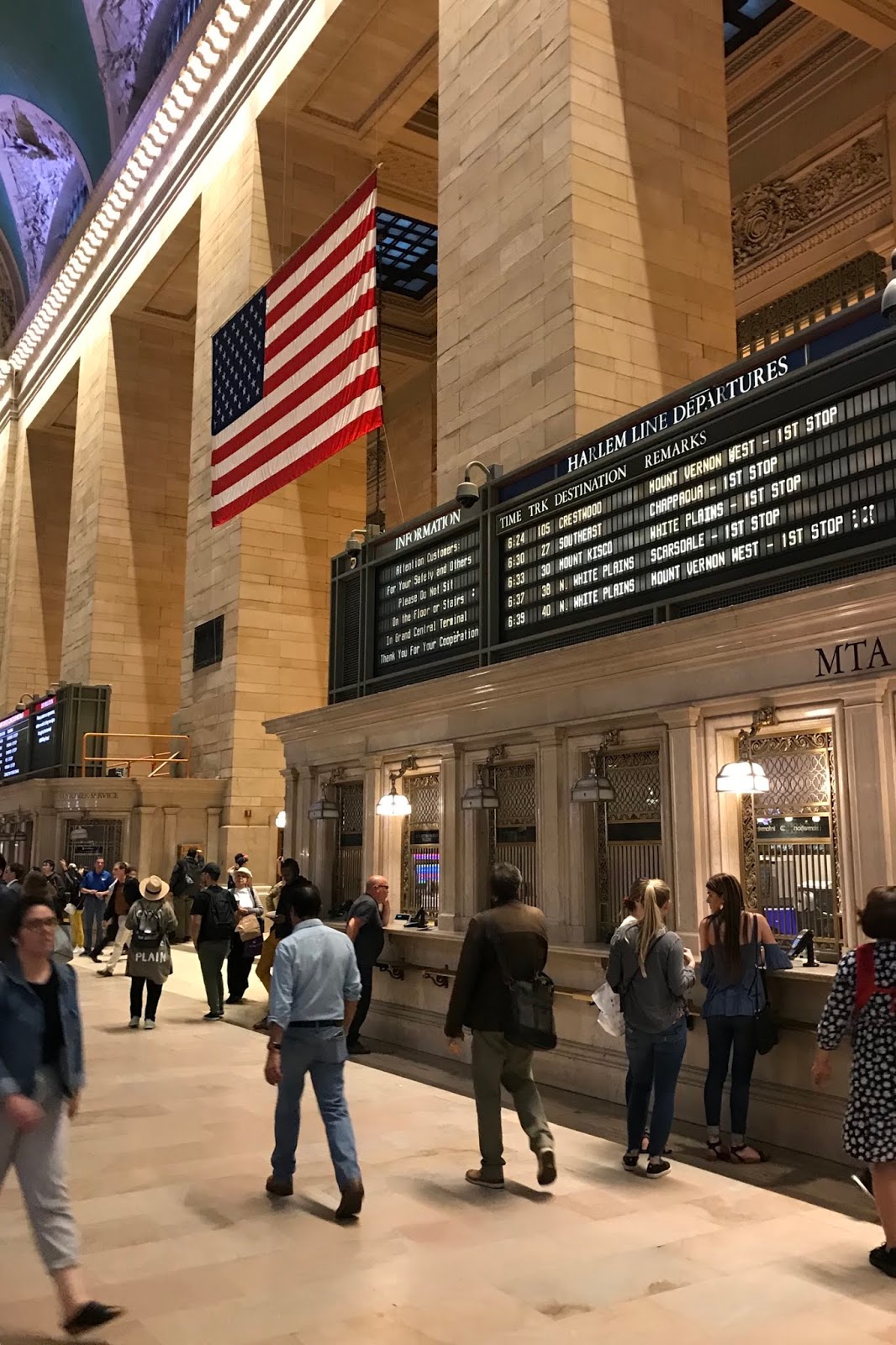
Ticket booths at
Grand Central Terminal
in New York City

Friday, May 31, 2019

Background: Resources for Train Travel

I used various resources in planning and getting ready for my trip, including the following books, magazines and websites. As my friend Tim Kelly says, never neglect the research function.
  • The Amtrak website, www.amtrak.com , which has all the information about routes, schedules and fares that you need to plan a trip.
  • All Aboard! The Complete North American Train Travel Guide by Jim Loomis. Jim is a veteran traveler who has written multiple editions of this practical guidebook about travel on Amtrak. He also has a comprehensive blog called "Trains & Travel with Jim Loomis."
  • Train: Riding the Rails That Created the Modern World - From the Trans-Siberian to the Southwest Chief, a 2014 book by Tom Zoellner which describes train trips he took in seven countries, including a trip from the northern tip of Great Britain to Land's End in the country where the railroad was invented, and a trip across the United States on Amtrak. Train received excellent reviews in the New York Times and other publications. Tom is a 1991 graduate of Lawrence University.  
  • Nothing Like it In the World by Stephen Ambrose. The story of the building of the Transcontinental Railroad, completed 150 years ago in 1869. Written by the popular historian who grew up in Wisconsin and graduated from the University of Wisconsin-Madison.
  • The Almanac of American Politics by Michael Barone and others, which provides capsule descriptions of all 50 states and all 435 Congressional districts. For each state and district, there's a brief description of its history, demographic characteristics, economy, and population and cultural trends. It also has detailed information about elections and politicians, but even if you're not interested in politics, you'll learn a lot from the background information about every area of the country.
  • "Trains" magazine, from Kalmbach Publishing of Waukesha, Wisconsin, with features about railroad history and current industry developments.
  • The Center for Railroad Photography & Art in Madison, Wisconsin, www.railphoto-art.org, which has online photo galleries, publishes a high-quality quarterly magazine and books, and puts on exhibitions around the country.
  • Various websites on railroad history, including www.american-rails.com .
  • Various travel guidebooks and videos from the Madison Public Library.  

Day 25: Final Leg - Chicago to Columbus, Wisconsin

The final leg of my trip took me from Chicago through Milwaukee to Columbus, Wisconsin, the Amtrak stop closest to Madison. I was on one of my favorite trains, the Empire Builder, actually repeating the first three hours of the trip. 

I enjoyed walking through the Chicago Loop at midday, with the cityscape dominated by skyscrapers and the Chicago River, and filled in with workers eating lunch and hurrying to their offices, the Elevated trains screeching overhead, and yellow cabs sounding their horns.

Then it was time for the train ride north through city neighborhoods and green suburbs, past factories and office parks, and into Milwaukee. From there a quick ride past lakes, farms, rivers and wetlands took me to Columbus, where our daughter picked me up for a ride home dominated by train stories.

It was a great trip, but it's always good to be home.

Midday at Federal Plaza in the Chicago Loop,
with sculpture by Alexander Calder and
buildings by Mies van der Rohe
The Third Ward on the Milwaukee River
just south of downtown Milwaukee,
where warehouses have been converted
to offices, stores and condos
Pewaukee Lake, west of Milwaukee
The Empire Builder getting ready
to head west from Columbus, Wisconsin
(I won’t be on it ... for now)

Thursday, May 30, 2019

Day 25: Back to Chicago - Circumnavigation Completed

Arrived back in Chicago on Thursday morning, May 30, on the Lake Shore Limited. My circumnavigation of the country has been completed! A few figures: In 25 days, I visited 31 states and traveled almost 8,500 miles by rail (and many more by streetcar, subway, bicycle, ferry, bus, car, running and walking - lots and lots of walking).

I’m feeling good. Maybe I’ll do another lap. (Just kidding - although I’m taking the Empire Builder from Chicago to Columbus, Wisconsin on Thursday afternoon, so I’ll do a second lap for about three hours.)

For lunch I went to the Berghoff, a classic, wood-paneled, old-line German restaurant in the Loop. When I worked as an Amtrak waiter in 1975, it was a traditional place for crew members to go at the end of a run for a sandwich and a beer. Back then, the bar didn’t have stools, so you’d stand at the rail, like in the old black and white photographs.

At Union Station I met Antje and Jan, two Germans who are bicycling across much of the United States. They'd ridden across the Appalachians and then taken the train to Chicago, and next are taking a train to Denver and then riding to Astoria in Oregon. I offered to buy them lunch at the Berghoff but they said they could get German food at home and instead rode off to do a bicycle tour along the Chicago lakefront in between trains. Good choice. I would have done the same thing.

Union Station, Chicago 
Map showing where I went on my trip
Jan and Antje from Germany,
cycling across the United States
The Berghoff, in the Loop
The bar at the Berghoff

Wednesday, May 29, 2019

Background: The Dining Cars

The dining cars on the trains are very enjoyable. They’re great places to meet people, enjoy the scenery and have a good meal. The food is good, with a half-dozen basic selections for each meal.

When I worked as a waiter on the dining cars in 1975, the trains had real china and linen tablecloths, and quite a few different dishes were cooked on board. The cooks could do amazing things in the small, cramped kitchen as the train rocked and rolled at close to 80 miles per hour. It’s not as fancy now but it’s still good.

In 1975, the dining cars mostly used a classic configuration that had been used for years. There were 12 four-top tables on one end of the car, and a pantry that the six waiters used along with a kitchen for the three cooks at the other end. A steward oversaw everything, seating customers and making sure everything ran smoothly. A car with the classic setup is on display at the California State Railroad Museum (see photos below).

The current dining car on the Empire Builder 
Display at California Railroad Museum
showing traditional dining car with waiter in pantry 
and cook in kitchen in background

Display at California Railroad Museum
showing kitchen on traditional dining car

Background: Why Travel by Train?

Traveling by train is interesting and enjoyable. It's a great way to connect with people, places and history.

It's easy to meet a wide variety of people on trains. Meals in the dining car provide opportunities for conversation. On the long-distance trains, the observation and lounge car is a great place to meet people.

Train trips help you appreciate how big and varied our country is. You see scenic landscapes, farms, small towns and cities. You also see factories, mines, oil rigs, warehouses, railyards, ships and barges, which remind you of the things that need to be done every day to keep the country running.

Train travel helps you think about our country's history too. Railroads changed the United States from a country of small farms and small towns to an industrial nation that expanded across the continent. They employed hundreds of thousands of people and dominated the economy and public attention in the Nineteenth Century the way the automobile and technology companies have in later decades. They're still vitally important to the movement of goods and people today.  

Train travel is relaxing, somewhat mesmerizing and a good way to get a different perspective on things. As the coffee cups say, “Amtrak: Change how you see the world.”


Amtrak: Change how you see the world

Background: Train Travel is Enjoyable and Relaxing

Trains may be the most enjoyable way to travel. Train travel is a great way to connect with people, places and the history of the country. ...